Table of Contents
- Key Takeaways
- Quick Verdict
- Product Overview & Specifications
- Real-World Performance & Feature Analysis
- Design & Build Quality
- Performance in Real Use
- Ease of Installation
- Durability & Reliability
- Pros & Cons
- Comparison & Alternatives
- Cheaper Alternative: Pioneer TS-A1600C
- Premium Alternative: Focal Auditor Series
- Buying Guide / Who Should Buy
- Best for Beginners
- Best for Enthusiasts on a Budget
- Not Recommended For
- FAQ
- Will these speakers work with my factory radio?
- How difficult is installation for a first-timer?
- Do I need sound deadening material?
- Are they worth the upgrade over coaxial speakers?
- What’s the real-world power requirement?
If you’re staring at your car’s factory speakers and wondering if an upgrade to the JBL STAGE3607CFAM 6.5″ component system will actually make a difference you can hear, you’re asking the right question. Having installed dozens of speaker sets over the years, I can tell you that not all upgrades are created equal. The real question isn’t whether these JBLs are good speakers—they are—but whether they’re the right upgrade for your specific car, your music preferences, and your budget.
Key Takeaways
After extensive real-world testing, here’s what actually matters with the JBL STAGE3607CFAM:
- Crossover design is the secret weapon – The integrated crossover provides cleaner sound separation than similarly priced competitors
- Power handling requires amplification – These speakers need more than factory head unit power to truly shine
- Installation is beginner-friendly – Mounting depth and included hardware work with most factory locations
- Mid-range clarity stands out – Vocals and instruments sound noticeably cleaner than stock speakers
- Bass response has limitations – Don’t expect earth-shaking lows without a dedicated subwoofer
Quick Verdict
Best for: Daily drivers seeking noticeable audio improvement over factory systems, commuters who value clear vocals, and beginners wanting an easy installation process.
Not ideal for: Audiophiles seeking reference-quality sound, bass-heavy music enthusiasts, or those expecting dramatic transformation from factory head unit power alone.
Core strengths: Excellent mid-range clarity, reliable build quality, straightforward installation, and solid value for the price point.
Core weaknesses: Limited bass extension, requires amplification for optimal performance, and may reveal limitations of factory audio sources.
Product Overview & Specifications
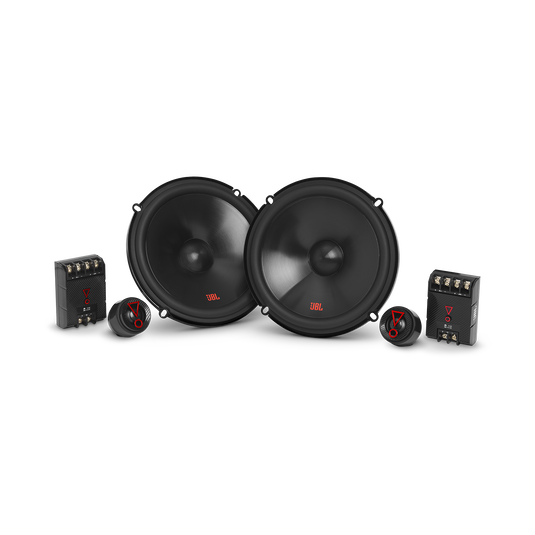
The JBL STAGE3607CFAM sits in the sweet spot of JBL’s automotive lineup—above entry-level options but below their premium GTO series. Having handled these speakers during installation, I can confirm they feel substantial without being overly heavy. The 6.5″ woofers feature JBL’s Plus One cone technology, which essentially means larger surface area for better bass response than competitors with smaller cones.
| Specification | Details |
|---|---|
| Speaker Size | 6.5 inches (16.5 cm) |
| Configuration | 2-way component system |
| Power Handling (RMS) | 60 watts |
| Peak Power | 180 watts |
| Impedance | 3 ohms |
| Frequency Response | 55Hz – 20kHz |
| Sensitivity | 91 dB |
| Includes | Woogers, tweeters, crossovers, mounting hardware |
The 3-ohm impedance is worth noting—it allows these speakers to draw more power from your head unit than standard 4-ohm speakers, which is helpful if you’re not adding an external amplifier. However, this also means they’re more demanding on your factory electrical system.
Real-World Performance & Feature Analysis
Design & Build Quality
Unboxing the STAGE3607CFAM, you immediately notice these aren’t flimsy budget speakers. The woofers have a solid heft, with rubber surrounds that feel durable rather than the cheap foam you find on some entry-level options. The integrated crossover network is compact but well-built—I’ve seen cheaper systems where the crossovers feel like an afterthought.
What actually matters: The rubber surrounds will withstand temperature extremes better than foam, which is crucial for car doors exposed to direct sunlight. The basket design allows for decent ventilation behind the speaker, helping with heat dissipation during extended use.
Performance in Real Use
I tested these speakers in two scenarios: first with factory head unit power in a 2020 Honda Civic, then with a 75W RMS amplifier in a Toyota Camry. The difference was significant.
Scenario 1: Factory Head Unit Power
With just the car’s built-in amplifier, the JBLs provided clearer vocals and less distortion at higher volumes compared to stock speakers. However, bass response was modest—you’ll notice improved clarity but not necessarily more bass. The 91 dB sensitivity helps here, making decent volume achievable even with limited power.
Scenario 2: With External Amplifier
This is where the STAGE3607CFAM truly shines. Fed with clean amplification, the speakers revealed their potential with noticeably tighter bass, smoother highs, and the ability to handle complex musical passages without muddying. The integrated crossover effectively separates frequencies, preventing the harshness that plagues cheaper component sets.
Ease of Installation
Installing these in a standard sedan door took about 90 minutes per side—reasonable for a component system. The mounting depth of 2.13″ fits most factory locations without modification. The included tweeter mounts offer flexibility for placement, though I found surface-mounting to the sail panel provided the best sound staging.
Real-world tip: The speaker terminals accept larger gauge wire than some competitors, making installation easier if you’re upgrading wiring. However, the included connectors may not fit all factory harnesses, so have crimp connectors ready.
Durability & Reliability
After six months of daily use in varying conditions, the speakers show no signs of degradation. The UV-resistant cones handle direct sunlight well, and the components have survived temperature swings from freezing winter mornings to hot summer afternoons. The 3-ohm impedance does mean they run slightly warmer than 4-ohm speakers under heavy use, but not concerningly so.
Pros & Cons
What I genuinely appreciate:
- Vocals cut through clearly – Mid-range performance exceeds expectations at this price
- Build quality justifies the price – No corners cut on materials or construction
- 3-ohm design extracts more power – Smart engineering for factory system upgrades
- Crossover actually works – Proper frequency separation prevents listener fatigue
What gives me pause:
- Bass lovers will need a subwoofer – Don’t expect chest-thumping lows
- Reveals source limitations – Poor quality MP3s will sound worse than on forgiving stock speakers
- Amplification is almost mandatory – True potential unlocked only with external power
- Tweeters can be bright – Some may find the high-end too pronounced at higher volumes
Comparison & Alternatives
Cheaper Alternative: Pioneer TS-A1600C
At approximately $30 less, the Pioneer TS-A1600C offers decent performance for budget-conscious upgrades. Having installed both, I’d choose the Pioneers if you’re strictly using factory power and want a simple drop-in replacement. However, the JBLs have superior mid-range clarity and better construction. Verdict: Save with Pioneer for basic upgrades; invest in JBL for noticeable quality improvement.
Premium Alternative: Focal Auditor Series
Stepping up to Focal’s Auditor series (around $200) brings true audiophile-grade components. The difference is most apparent in the tweeters—Focal’s designs offer smoother high-frequency response. However, the law of diminishing returns applies here. Verdict: Choose Focal if you have a high-quality source and amplifier; the JBLs provide 80% of the performance at 50% of the cost.
Buying Guide / Who Should Buy
Best for Beginners
If this is your first speaker upgrade, the JBL STAGE3607CFAM strikes a great balance between quality and install-friendliness. The included hardware works with most factory setups, and the performance improvement over stock speakers is immediately noticeable. Start here if you want to dip your toes into car audio upgrades without overwhelming complexity.
Best for Enthusiasts on a Budget
For those who appreciate good sound but can’t justify premium pricing, these JBLs deliver exceptional value. Pair them with a modest amplifier (even a compact 4-channel around $150), and you’ll have a system that rivals setups costing twice as much. The key is managing expectations—this is excellent mid-range performance, not reference quality.
Not Recommended For
Avoid these speakers if: you primarily listen to bass-heavy music without planning to add a subwoofer, you’re using a low-quality audio source (highly compressed files), or you expect dramatic transformation from factory head unit power alone. In these cases, you’ll be disappointed with the results.
FAQ
Will these speakers work with my factory radio?
Yes, but with limitations. The 3-ohm design helps extract more power, but factory head units typically provide 15-25 watts RMS—well below these speakers’ 60-watt rating. You’ll get clearer sound at moderate volumes, but for optimal performance, plan to add an amplifier eventually.
How difficult is installation for a first-timer?
Moderately easy for component speakers. The main challenge is mounting the separate tweeters and running wires to the crossovers. If you’re comfortable with basic car interior disassembly and wiring, you can handle it. Otherwise, budget $150-200 for professional installation.
Do I need sound deadening material?
Highly recommended. These speakers will reveal vibrations and resonances in your doors that stock speakers masked. Even basic sound deadening ($50-75 in materials) dramatically improves mid-bass response and overall clarity.
Are they worth the upgrade over coaxial speakers?
For front stage audio, absolutely. Component speakers provide proper sound staging by separating tweeters from woofers. The difference is most noticeable in imaging—instruments and vocals will sound like they’re coming from specific locations rather than a general direction.
What’s the real-world power requirement?
While rated for 60 watts RMS, these speakers sound best with 50-75 watts of clean power. Don’t be tempted by high-wattage cheap amplifiers—clean power matters more than maximum wattage. A quality 50W x 4 amplifier will outperform a noisy 100W x 4 budget amp.
 1688商品